
When an Inspection Model Has Seconds to Matter
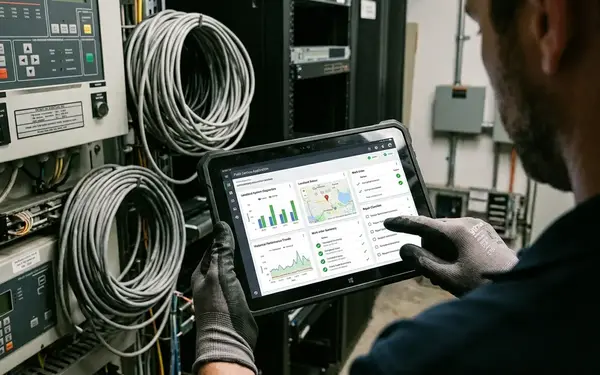
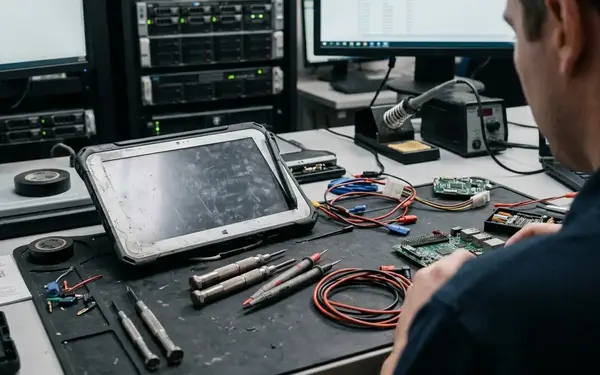
Consider a representative workflow inside a chilled warehouse equipment room. A field technician opens an inspection application on a rugged tablet, aims its camera at a vibrating compressor, and waits for the image to settle. As the technician moves between Wi-Fi access points, connectivity disappears for roughly 8 to 20 seconds and changes networks before synchronization finishes.
The model flags a possible defect locally. That result has value only if the surrounding application can turn it into a safe, usable action.
The application still has to preserve the image, associate it with the correct equipment record, express confidence in terms the technician can interpret, and offer an approved response. It must also survive the network change without losing the attachment or submitting the same inspection twice. Human confirmation and later review remain part of the path.
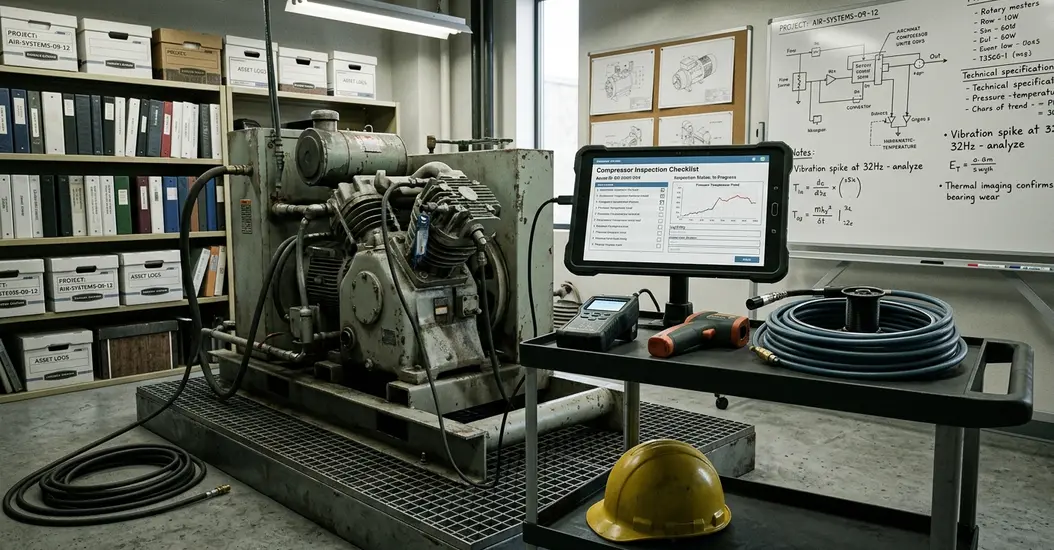
A useful test stores the capture timestamp, equipment identifier, model-package version, confidence band, technician response, and synchronization state as separate fields. Embedding those details only in a diagnostic message makes reconstruction difficult after the record has moved through several systems.
Protect The Capture
Treat the image, structured inspection fields, and queue entry as one recoverable operation. A tablet that closes under memory pressure must reopen with the attachment and its synchronization state intact.
This scene exposes the central architectural tension. Fast inference can support an immediate field decision, while confidence handling, evidence retention, deterministic safety rules, and an offline recovery path determine whether the decision belongs in production.
On-Device, Near-Edge, and Cloud AI Are Different Bets
Placement should be classified by locating the actual inference runtime. Marketing labels tend to blur this point, especially when a mobile interface calls a model through several hidden services.
On-Device Execution
On-device inference runs inside the phone, tablet, wearable, or dedicated handheld used in the workflow. It can avoid a network round trip and keep captured material on the device, subject to the application’s own synchronization policy. The cost appears in package size, peak memory, accelerator requirements, storage consumption, battery use, and support for older hardware.
Near-Edge Execution
Near-edge inference runs on a reachable local gateway, vehicle computer, branch server, or site appliance. Multiple mobile clients can share stronger compute capacity without sending every request to a central cloud service. This design introduces another dependency: the gateway must remain reachable, compatible, current, and trustworthy.
A reachable gateway can still be unsafe. During an external outage, for example, it may continue serving stale equipment limits. The inference path remains technically available while the recommendation path has lost valid operating context.
Cloud and Hybrid Execution
Cloud inference centralizes compute, package deployment, telemetry, and reference data. Its usefulness in a field task follows the quality of the complete route from device to service and back. Hybrid pipelines place bounded, time-sensitive work near the technician and defer heavier analysis, fleet comparison, or downstream review until synchronization.
Document the route as individual hops: mobile process to operating-system service, device to local gateway, gateway to site service, and site to cloud. Each hop should be exercised during normal operation and partial failure. The placement review should also inventory model-package size, cold-start memory, accelerator needs, queued-record storage, credential lifetime, and permitted reference-data age.
No placement is intrinsically preferable across hardware classes, network topologies, workloads, and jurisdictions. The comparison has to follow the devices and data path that the deployment will actually use.
Compare the Deployment Options by Failure Mode
Begin with the business’s acceptable degraded mode, then eliminate placements that cannot preserve it. If a technician must capture evidence and make a bounded triage decision without a route, a cloud-only design cannot carry that part of the workflow.
Execution Placement by Operational Consequence| Criterion | On-device | Near-edge | Cloud | Hybrid |
|---|---|---|---|---|
| Response latency | Avoids network travel; cold start, preprocessing, storage, and heat still matter. | Adds a local network hop and gateway queue. | Depends on the complete remote route. | Fast for local stages; deferred stages finish later. |
| Disconnected operation | Can continue within local data and credential limits. | Continues while the gateway remains reachable. | Stops or degrades when the route is lost. | Preserves selected functions and queues the rest. |
| Sensitive-data exposure | Can limit transfer beyond the device. | Keeps processing within the local site path. | Requires transfer to central infrastructure. | Can filter or extract locally before transfer. |
| Compute limits | Constrained by mobile memory, accelerators, storage, and heat. | Shares stronger local capacity across clients. | Offers centralized compute capacity. | Splits work according to demand and urgency. |
| Battery impact | Inference and sustained camera use draw from the device. | Offloads inference but retains network activity. | Reduces local compute while requiring radio use. | Varies with the chosen partition. |
| Deployment reach | Every supported device must receive a compatible package. | Each site or vehicle needs a maintained appliance. | Central service changes can reach connected clients. | Coordinates releases across several layers. |
| Update control | Must account for delayed, interrupted, or skipped device updates. | Can be managed by gateway or site cohort. | Centralized, with client compatibility still required. | Requires compatibility across local and remote units. |
| Telemetry | Queues observations until a route returns. | Can aggregate locally during an external outage. | Central visibility is immediate when connected. | Combines delayed local evidence with central records. |
| Rollback | Must preserve a complete preceding package on supported devices. | Can roll back by appliance cohort. | Central rollback is direct but may affect many clients. | Rollback order must respect cross-layer compatibility. |
| Partial failure | May infer while remote policy or reference lookups fail. | May remain available with stale central context. | May be reachable while the local appliance is unavailable. | Needs explicit behavior for every broken dependency. |
Measure the interval from camera action to a usable worker prompt. That interval includes focus, decode, preprocessing, inference, rules evaluation, local database access, and screen rendering. A low inference time does not guarantee a fast workflow when another stage dominates the delay.
Partial-failure tests should separate two cases: the device reaches the gateway while the gateway cannot reach central services, and central services remain available while the local appliance is down. These conditions produce different recovery duties and should never be collapsed into a generic “offline” result.
Where Edge AI Changes the Field Workflow
The strongest edge use cases alter a specific field action before upload. A workflow-delta test makes that contribution visible.
Visual Inspection Assistance
Local inference can reject an unusable image, request another angle, identify a likely anomaly, or move a record higher in the review queue. These interventions occur while the technician can still adjust the camera or inspect the equipment. Classification that merely adds a label for a later reviewer offers a different, less immediate benefit.
Bounded Diagnostic Guidance
A diagnostic tool can combine local sensor readings, equipment context, and a constrained recommendation set. Deterministic limits should govern safety thresholds and escalation. The model can rank approved actions, while the application records the evidence and the technician’s response.
Local Capture and Extraction
Speech capture, document extraction, and classification can reduce unnecessary transfer of sensitive material. A local process might extract required fields, validate completeness, and retain the source according to an explicit evidence policy. That design also gives the worker an opportunity to correct a name, identifier, or measurement before leaving the site.
Exercise these workflows with a disconnected field script lasting 45 to 90 minutes. Include application suspension, a device lock, a duplicate capture, and restored connectivity while records remain queued. Capture timestamps for task opening, first evidence, model response, technician confirmation, queue commit, synchronization attempt, server acknowledgment, and reviewer disposition.
Measure The Delta
Approval should identify the field action changed by local processing: recapture, triage, validation, extraction, or escalation. “AI available on the tablet” does not describe an operational improvement.
Claims That Collapse Outside the Demonstration
An offline claim becomes meaningful only after its dependencies are removed. Cached credentials may expire. Reference retrieval may be blocked. Policy evaluation, telemetry upload, time synchronization, or the update service may become unavailable. A dependency map should state which functions survive each condition.
One revealing failure occurs when a model returns a local result but the application cannot display an approved action because its policy lookup still requires a remote service. The model is offline-capable; the task is stranded.
Curated demonstrations conceal the same problem at the input layer. Repeat the task under low illumination and glare, with a partially damaged label, gloved input, background machinery noise, and a nearly full local store. Keep the device processing continuously for 20 to 30 minutes so thermal behavior and sustained memory pressure enter the test.
Synchronization deserves equal scrutiny. A polished demonstration often ends when the result appears on screen, even though the record still has to survive queuing, retry, schema validation, conflict handling, and acknowledgment. Interrupting that sequence reveals whether the application can distinguish an unsent record from one accepted centrally.
Constrain Field Guidance
An assistant that produces plausible maintenance instructions without approved procedures or an explicit escalation path creates an uncontrolled decision channel. Require bounded recommendations, cited procedure identifiers within the application, and a visible human override.
So when a vendor demonstrates an inspection model that flags a compressor defect in a fraction of a second, what happens to that record when the tablet locks mid-sync, the label is half-scratched, and the policy service is unreachable — does the task complete, or merely appear to?
Partition the Workflow Before Choosing the Model
Model selection comes after workflow partitioning. Draw the task as discrete stages: capture, validation, preprocessing, inference, deterministic rules, local commit, human confirmation, synchronization, and downstream review.
- Set latency tolerance. Identify which stages must complete while the technician can still act and which can wait for synchronization.
- Mark data boundaries. Decide where source images, speech, extracted fields, equipment context, and diagnostic evidence may be stored or transferred.
- Assign compute. Place each stage on the device, local gateway, or cloud according to memory demand, accelerator availability, battery cost, and package size.
- Define recovery. Specify what happens after application suspension, gateway loss, an interrupted write, a schema change, or device replacement.
- Preserve human control. Place confirmation and escalation at the point where the worker has enough evidence to make a bounded decision.
Keep deterministic rules around safety thresholds, required fields, authorization, and escalation. A model may estimate image quality or rank likely conditions; the application should still enforce whether a reading crosses a mandatory limit or whether a user has authority to approve the next step.
Every offline record needs a durable client-generated identifier. Retain capture time, last-modified time, model version, schema version, retry count, synchronization state, and the identifier of any superseded record. Those fields support conflict handling and later reconstruction without relying on free-text diagnostics.
Recovery testing should extend through roughly 72 hours offline and include interruption between local commit and queue registration, device replacement before upload, gateway loss during transfer, and synchronization after the schema or model package changes. This sequence tests the mobile system around the model, where many field failures actually surface.
A Model Update Is a Mobile-System Change
The model, preprocessing code, labels, thresholds, and decision rules form one compatibility-controlled release unit. Changing a threshold while leaving old labels or preprocessing logic in place can alter behavior as surely as replacing the model itself.
The mobile client should verify a signed package before activation, check storage and runtime compatibility, and retain a complete preceding release for rollback. Interrupted downloads must leave the application with either the old release or the new release—never a mixture.
Exercise interruption immediately after metadata receipt, during transfer, after verification, and during activation. Reopen the application at each point and confirm that it can process or queue a record with a coherent release unit.
An initial device cohort should remain under staged observation for roughly 24 to 72 hours before expansion. Compare cold-start failures, local overrides, queue errors, and rollback requests by hardware class. This window cannot predict every field condition, but it exposes compatibility problems before a package reaches the broader device population.
Each recommendation record should identify the model-package version that produced it. Later review can then reconstruct the decision context, including the labels, thresholds, preprocessing behavior, and deterministic rules active at capture time.
Make Edge AI Prove Its Architectural Value
The final review begins with the workflow step claimed to improve and the evidence that will verify it. The architecture decision record should state explicit acceptance values for offline duration, end-to-end prompt delay, queue capacity, reference-data age, battery reserve, retry interval, and evidence retention.
- How long must the worker continue without central connectivity?
- What is the maximum acceptable delay from capture to a usable prompt?
- Which data may remain on the device, reach a gateway, or enter cloud services?
- Which hardware classes can run the complete release unit under sustained load?
- Where can a technician override, confirm, or escalate a recommendation?
- What does degraded mode permit when authentication, policy, retrieval, or telemetry fails?
- Which events remain observable after a disconnected session?
- How will rollout stop, and how will the preceding release be restored?
A release rehearsal should cover package deployment, one failed activation, rollback to the preceding unit, creation of an offline record under the old version, and later synchronization after the service adopts the new schema.
On-device execution favors immediacy and reduced transfer. Near-edge execution provides shared local capacity. Cloud execution favors centralized scale and control. Hybrid designs exchange architectural simplicity for a broader set of recovery options.
Proceed when the team can name the improved workflow step, the accepted failure mode, and the evidence that will verify the result. Which field decision becomes measurably safer or faster when inference moves closer to the worker?







Join the Conversation
Share your thoughts.
Your Comment