
The Modernization Trap: Faster Mobile Apps, Weaker Operations
Most enterprise mobility programs start with the wrong question. A team gathers, someone pulls up a vendor comparison, and the first thing on the whiteboard reads: which platform should we use? That question feels productive. It is also premature.
The safer opening question is quieter and harder: which operational failure would be unacceptable if the mobile estate changed? Ask that before any demo, and the whole modernization effort reorganizes itself around what matters.
Consider a short pre-selection assessment run over roughly two weeks in April 2024, before any vendor demonstration or prototype approval. The review room does not debate frameworks. It sequences three risks and refuses to move until each has a name: field workflow interruption, loss of trusted status data, and unclear support ownership after release. Only then does anyone earn the right to compare architectures.
Framed this way, modernization stops being a rewrite project and becomes a decision problem. The method exists to protect field workflows, data continuity, security expectations, and business accountability. The outputs are honest verbs, not promises: refactor, rebuild, replace, wrap, or retire.
This article takes an archival, analysis-led approach consistent with the site's focus on enterprise mobility, rapid application development, occasionally connected applications, and the Microsoft.NET mobile ecosystem. It borrows examples from earlier work and treats them as patterns to reason with, not endorsements to repeat.
Define the Decision Boundary Before You Compare Platforms
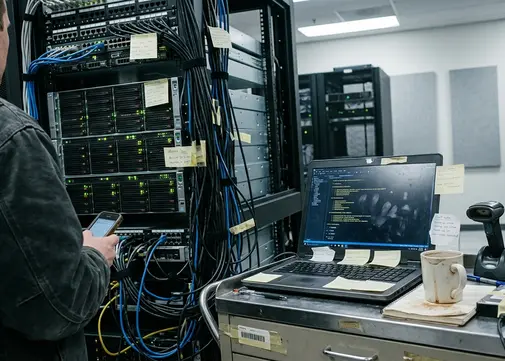
The first protocol step produces a single page. Not a specification, not a backlog. A one-page decision boundary that states what is being modernized, what is deliberately left alone, and which operational risks are in scope.
Keep it small enough to read in a 45-minute architecture session with product ownership, security, support, and one field operations representative in the room. That last seat is non-negotiable. The person who actually closes out a delivery on a scanner will catch omissions that no requirements document surfaces.
The boundary variables
Every boundary document records the same variables so two teams can compare their situations honestly:
- User role
- Device ownership model
- Network dependency
- Regulated or confidential data exposure
- Back-end integration points
- Release cadence
- Support ownership
A workable drafting window runs about a week in early May 2024, followed by a single approval review shortly after. One draft, one review, one signature. Boundaries that stay open for weeks tend to absorb every adjacent ambition in the building.
That absorption is the real hazard. Search visibility, campaign tracking, and customer acquisition tooling all crowd into modernization conversations because they touch software too. Exclude them unless they directly change the mobile task being modernized. If a marketing system does not alter what a field user does on shift, it belongs to a different project with a different owner.
Build an Evidence Ledger From Real Workflows
The evidence ledger is the central artifact of this method. It is a structured record of observed workflows, constraints, exceptions, dependencies, and unresolved assumptions. Everything downstream — the mobility map, the risk scores, the quality gates, draws from it.
Build it from observed work, not assumed requirements. Interview field users. Review support tickets. Inspect synchronization logs where they exist. Watch handoffs happen. Document failure cases in plain language rather than pretending you already understand them.
Six to ten representative workflow observations is enough. This is not a statistical sample; it is a way to expose handoffs, exceptions, and the undocumented workarounds people invent to get through a shift. Run collection across about three weeks in June 2024, and finish the support-ticket review before field observation so observers already know which failure cases to watch for.
What each ledger row holds
Each entry captures workflow name, actor, device, network state, data created, data consumed, exception path, privacy sensitivity, business impact, and modernization candidate. The columns force specificity. "The app is slow" becomes "the in-transit exception step requires three screen transitions on a shared device with intermittent coverage."
Logistics gives a grounded example. Robert Aldridge's archived article from late 2020 identifies secure transportation of goods and package tracking, naming FedEx as a package tracking service provider. Treat that as a workflow pattern, not a platform choice. For a delivery-status workflow, capture at least four status moments: pickup confirmation, in-transit exception, failed delivery attempt, and final handoff. Each moment carries its own network assumptions and its own way of going wrong.
Map Mobility Modes: Connected, Offline, and Occasionally Connected
Mobility modernization fails most often at a single false assumption: that every mobile workflow is permanently connected. Field work is not permanently anything. Convert the ledger into a mobility mode map by assigning each critical task to one of three operating assumptions.
- Always connected — continuous network access is required for the task to function.
- Offline tolerant, the task is deliberately completed offline and needs no live server contact.
- Occasionally connected, local work happens during intermittent connectivity and reconciles with central systems later.
That third mode is where the interesting failures live. Picture a driver who records a delivery exception while offline, reconnects after the route has already closed, and watches the central system display the late update as current rather than delayed. The form submitted fine. The failure is trust in status timing, and no submission button fixes it.
Controlled variables per task
For each mode, pin down authentication state, local storage behavior, conflict resolution, retry behavior, device time, audit trail, and user visibility into sync status. Run a validation window over about two weeks in July 2024 that includes at least one controlled device clock mismatch and one forced network loss during a save action. The mapping output is one row per critical task, with columns for connection assumption, local data created, server dependency, recovery requirement, and user-facing sync message.
This method is strongest for operational mobile systems with repeatable tasks and observable handoffs. It is less useful for exploratory consumer-facing features where the workflow itself is still being invented.
Score Operational Risk Before Technical Preference
Score risk only after the workflow evidence and mobility map exist. Do it earlier and you end up rewarding the option someone already liked. Rank every candidate against the same tasks, the same network assumptions, and the same support model.
Use qualitative labels rather than fabricated numbers: low, medium, high, and blocking. Every high or blocking rating requires a one-sentence evidence reference pulled from the ledger. A rating with no evidence behind it is an opinion wearing a spreadsheet costume.
The seven risk dimensions
Score against business interruption, data loss exposure, security sensitivity, user workaround likelihood, integration fragility, support burden, and reversibility. That last dimension — can we back out cleanly?, gets skipped far too often and hurts the most when ignored.
Budget about 90 minutes for the scoring session, and hold a second, shorter reconciliation meeting in mid-August 2024 if security and field operations disagree. They usually disagree somewhere, and that disagreement is signal.
Test the sharp cases directly. For tracking workflows, check whether a delayed status update can be distinguished from a missing status update once the device reconnects. If the system cannot tell the two apart, the operational risk is higher than any framework benchmark suggests.
Control Culture, Adoption, and Burnout Variables
Adoption is an operating condition, not a training afterthought. Julia Sluder's archived definition from late 2018 describes workplace culture as the combination of employee actions, personality, and daily interactions. Mobile process legitimacy lives inside that culture, not inside the training deck.
A supervisor accepts duplicate paper notes during peak load because the mobile task takes too many screen transitions. That is an adoption failure, and no amount of documentation prevents it. The risk came from shift pressure and peer habit.
Adoption test variables
Observe task duration, cognitive load, duplicate entry, supervisor escalation path, field support availability, and the ability to complete work under time pressure. Run the observation period over about two weeks in September 2024, covering at least one early shift handoff and one late-day closeout task. Measure task duration operationally with start and stop timestamps, but resist converting one measurement into a universal productivity claim.
Flag any design that makes users retype the same job identifier into both the mobile app and a separate back-office screen during normal completion. Duplicate entry is where quiet resentment accumulates. Sluder's archived material describes burnout as a toxic state of exhaustion affecting company culture, so a modernization plan that adds hidden administrative work to mobile users is buying that outcome on installment.
Design the Data-Capture and Privacy Tests
Modernization usually changes what data is collected, when it is collected, and who can access it. Make data capture a decision gate before pilot expansion, not a discovery after launch.

Julia Sluder's early-2019 Ads Systems article on mobile coupons is a narrow example from the customer acquisition stage, where a coupon can support data collection. Read it narrowly. It does not generalize into marketing performance claims, and it should not. The useful move is translation: what new data does the enterprise app collect, and at what point in the workflow?
Data classes and security variables
Test across customer data, employee data, location data, transaction data, operational status data, and device metadata. Schedule the privacy review for mid-October 2024, before the controlled pilot, so optional collection behavior can still be changed while changing it is cheap.
Pin the security variables too: local encryption expectation, authentication timeout, role-based access, audit logging, and a deletion procedure for lost, reassigned, or retired devices. Then run the decline-path test. Confirm the user can still complete the core task when optional location capture, camera access, or notification permission is unavailable. A workflow that quietly breaks without an optional permission was never optional.
Run a Quality Gate Like an Editorial Revision Cycle
Robert Aldridge's archived article from spring 2020 defines quality control as an editorial revision process for translations. That framing adapts cleanly to enterprise mobility. Treat each candidate design as a manuscript that must survive staged revision before anyone calls it finished.
The gate sequence
Move each design through five revisions in order: workflow accuracy, security, offline behavior, integration reliability, and support readiness. Run one gate every two working days across early-to-mid November 2024. When a blocking item cannot be resolved, carry it into a named risk register with an assigned owner rather than letting it dissolve into meeting notes.
Each gate works from the same checklist: evidence reviewed, assumptions challenged, exception paths tested, rollback plan drafted, support notes written, and unresolved risks assigned an owner. The warehouse case earns its place here — a scanner keeps a valid local session after a network drop, but the user role changes centrally during the outage. The reconciliation design has to decide whether the pending action stays valid. That decision belongs in a gate, not in a production incident.
Note: For confidential projects, use masked operational records unless a reviewer explicitly needs live-like data to verify a failure path. Add non-disclosure agreements as a contextual confidentiality mechanism when prototypes expose operational data, customer details, or proprietary workflows.
Only after the ledger, the mobility map, the risk scores, and the quality gates exist should the team compare paths: build a new app, buy a packaged capability, wrap a legacy system with a mobile layer, replace the workflow, or retire the capability. For.NET-aligned estates, test skill fit through maintainability and integration evidence rather than assuming suitability from the existing language stack. If you are weighing a cross-platform rebuild, read the Microsoft.NET MAUI documentation against your actual integration evidence, not against its feature list.
The method protects operations first and picks tools last. Evidence ranks options; preference does not. Your next step is concrete: open a blank page today and draft the one-page decision boundary for the single mobile workflow whose failure your business could least afford. Name the in-scope operational risks, book the 45-minute review with security and one field operations representative, and refuse to open a vendor comparison until that page is signed.











Join the Conversation
Share your thoughts.
Your Comment